What to Eat in Milan: 10 Dishes Worth the Trip
Milanese food reads like a history of everyone who ever ran the city: Spanish meatballs, an Austrian bread roll, a saffron joke from the Duomo's construction site. Here are ten dishes worth the trip, the story behind each one, and where to try it.
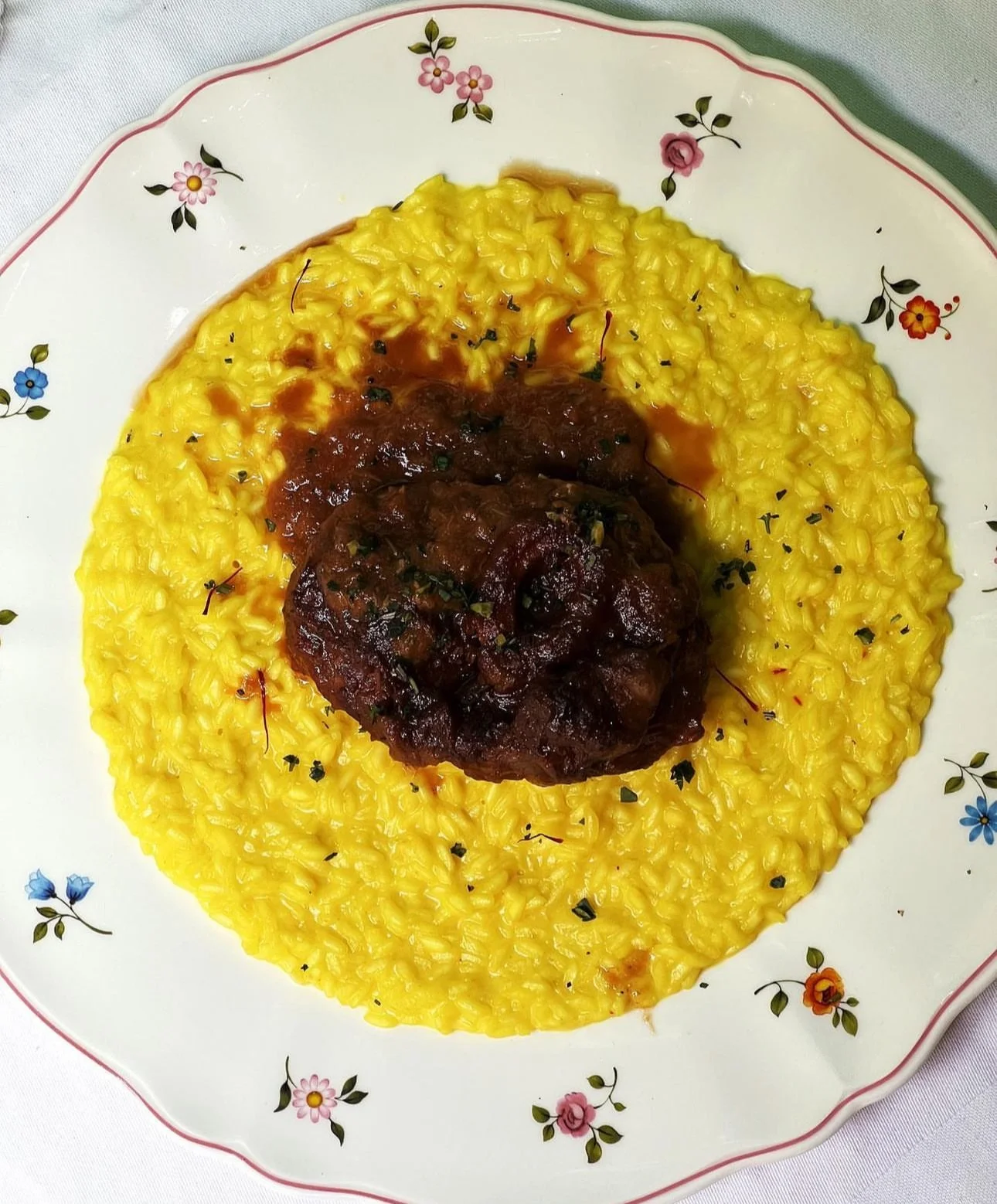
01 / RISOTTO ALLA MILANESE
Milan's golden risotto owes its color to saffron and, according to legend, to a prank. In 1574, a Flemish glass master named Valerio was working on the Duomo's stained-glass windows. His assistant, nicknamed Zafferano, liked to add saffron to his pigments to make them glow. At the master's daughter's wedding, he slipped some into the rice. The guests were confused, then converted.
Where to try it: Trattoria Milanese dal 1933, Via Santa Marta 11
02 / COTOLETTA ALLA MILANESE
A veal chop on the bone, breaded and fried in butter. It comes either thick and pink or pounded wide into what the Milanese call an orecchia d'elefante, an elephant's ear.
Milan and Vienna have argued for two centuries about who breaded it first. The Milanese point to a twelfth-century banquet menu from the basilica of Sant'Ambrogio. Historians suspect that dish was closer to a scaloppina with bread. The diplomatic answer: the schnitzel is thin and boneless, while the cotoletta keeps its bone.
Where to try it: Trattoria del Nuovo Macello, Via Cesare Lombroso 20.
03 / OSSOBUCO
A slice of veal shank braised slowly with the marrow sitting in the middle like a small, rich secret. The name means "bone with a hole." It arrives topped with gremolata, a fresh mix of lemon zest, garlic and parsley, and usually on a bed of risotto alla milanese.
Where to try it: Trattoria Masuelli San Marco, Viale Umbria 80, a family trattoria since 1921, with Gio Ponti lamps from the 1930s.
04 / CASSOEULA
Cassoeula is a winter stew of pork (ribs, rind, trotters and small sausages called verzini) slow-cooked with Savoy cabbage. Tradition says the cabbage must catch the first frost, which makes it sweeter.
It belongs to January 17, the feast of Sant'Antonio Abate, protector of animals, which traditionally closed the pig-slaughtering season.
Where to try it: any traditional trattoria from late fall to February.
05 / MONDEGHILI
Milan's meatballs are made from leftover boiled meat, bread soaked in milk, egg and cheese, then breaded and fried in butter. The name is a small history lesson. It comes from the Spanish albóndiga, a souvenir of Spanish rule between 1535 and 1706, and the Spanish word itself comes from the Arabic for hazelnut.
Where to try it: at Trattoria del Nuovo Macello while you wait for your cotoletta, or with an aperitivo almost anywhere in town.
06 / POLENTA E GORGONZOLA
Gorgonzola is not only a cheese. It is also a town just outside Milan, and you can take the green metro line there. Cheese has been made in the area since the Middle Ages. The local legend involves a cheesemaker who left his curds out overnight because he was in a hurry to see his lover. The result was blue.
Order gorgonzola dolce, the soft, creamy one, melting over a plate of warm polenta.
Where to try it: most trattorias in the cooler months. Or buy a wedge at any cheese counter and eat it with the next dish on this list.
07 / MICHETTA
The Milanese bread roll is star-shaped, crackly and almost completely hollow. It started as the Austrian Kaisersemmel, which arrived with the Habsburgs in the 1700s and went soggy in Milan's humid air, so local bakers took out the crumb.
Its name comes from micca, from the Latin mica, meaning crumb. It is a bread named after the one thing it doesn't have. Eat it the classic way, with mortadella.
Where to try it: Davide Longoni, the baker behind the michetta's comeback.
08 / PANZEROTTO AT LUINI
Technically, it is not Milanese at all. The panzerotto comes from Puglia: a half-moon of dough filled with tomato and mozzarella, fried until it puffs. But the Luini family has been making them steps from the Duomo since 1949, and the Milanese, who rarely eat on the street, make an exception here.
Where to try it: Luini, Via Santa Radegonda 16.
09 / PANETTONE
Milan's Christmas bread is tall and airy, with raisins and candied citrus. The old legend credits a kitchen boy named Toni who saved a Sforza feast, hence pan de Toni.
The more charming tradition is quieter. The Milanese save a slice for February 3, the feast of San Biagio, protector of the throat, and eat it for luck against winter colds. As the old saying goes, "San Bias el benediss la gola e el nas": Saint Blaise blesses the throat and the nose.
Where to try it: Pasticceria Marchesi, Via Santa Maria alla Porta 11/a, open since 1824 and owned by Prada since 2014. In Milan, even the pastry has a fashion connection.
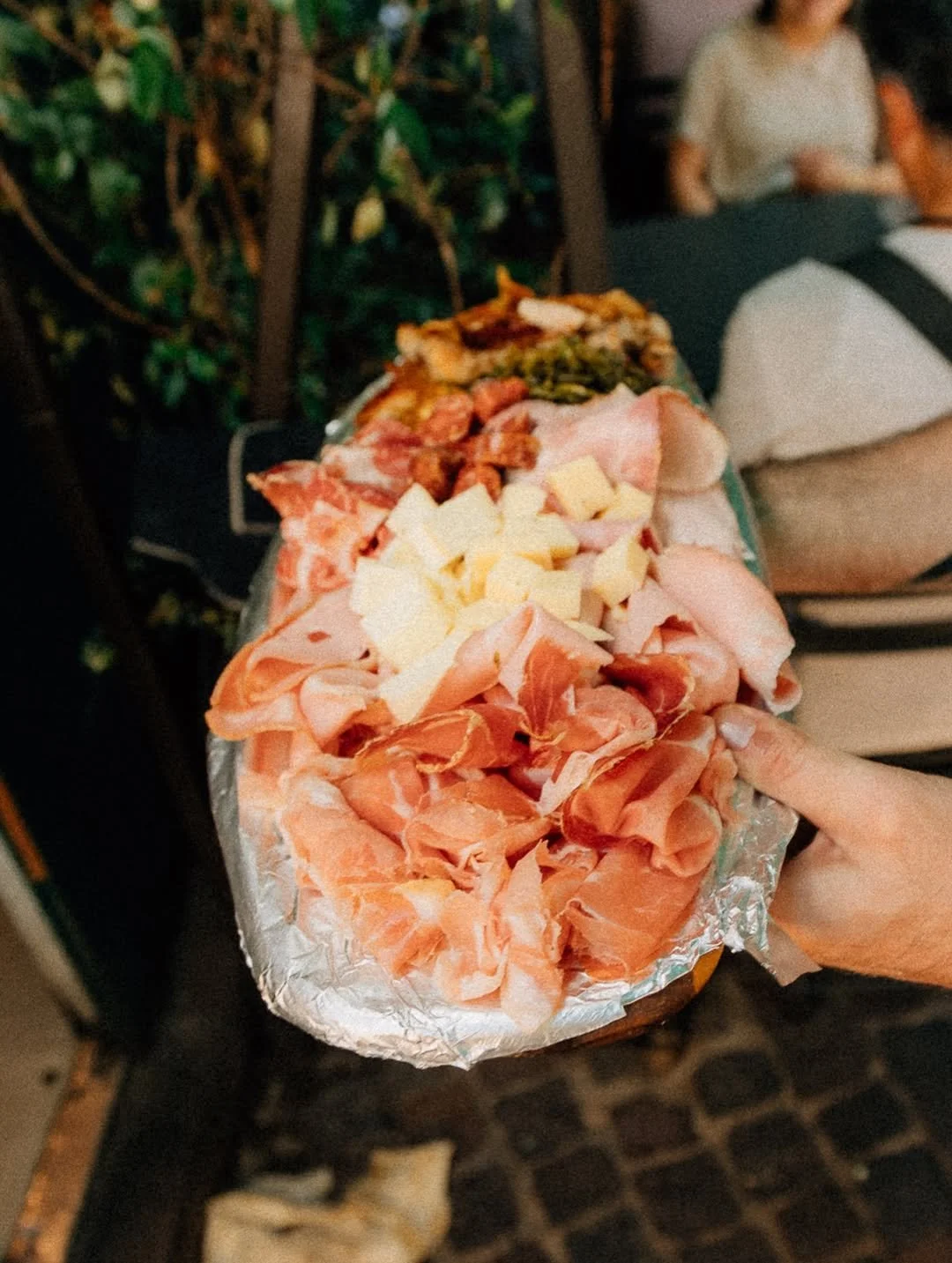
10 / APERITIVO AT CAMPARINO
In 1867 Gaspare Campari moved his bar into the brand-new Galleria, and his son Davide was born in the building that same year. In 1915 Davide opened Camparino at the Galleria's entrance, facing the Duomo: a bar made for standing, drink in hand, before dinner. Milan's aperitivo still looks a lot like that.
Order a Campari Seltz, or an Americano, which began as the Milano-Torino: Campari from Milan, vermouth from Turin.
Where to try it: Camparino in Galleria, Piazza del Duomo 21
SOURCES
Google Arts & Culture, The Legend of Risotto alla Milanese
Gambero Rosso, The true story of the cotoletta alla milanese
Michelin Guide, Trattoria del Nuovo Macello
My Art Guides, Trattoria Milanese dal 1933
Le Petit Journal, Milan's best trattorias
TableJourney, Trattoria Masuelli San Marco
Gambero Rosso, Davide Longoni's michetta
MilanoFree, Panettone di San Biagio
